The Group Travel Dropout Tax: 18 Trips Compared
Multiple destinations
Research dataset
Download the modeled data behind this benchmark
The 18 standardized celebration, ski, and Formula 1 trip scenarios used in Claira's Group Travel Dropout Tax benchmark, including modeled headcount, expected per-person cost, and the added cost per remaining traveler after one dropout.
Standardized modeled planning scenarios only. These files are not live prices, customer-trip data, market averages, observed cancellation statistics, or forecasts.
A traveler dropping out of a group trip does not just remove one person's share. If the group has already committed to a house, hotel configuration, private transfer, table, boat, driver, or other fixed booking, the same cost gets divided among fewer people.
Claira calls that increase the dropout tax.
To quantify it, we combined the standardized scenarios from three existing Claira benchmarks: six celebration destinations, six ski trips, and six Formula 1 weekends. That gives us 18 modeled trips with group sizes from six to ten travelers.
This is not a survey of actual cancellations and it is not a live-price study. It is a transparent stress test of the same fixed-cost rule across different trip types.
The 18-trip dropout benchmark
| Trip | Type | Modeled travelers | Expected / person | +1 dropout cost / remaining traveler |
|---|---|---|---|---|
| New Orleans | Celebration | 10 | $1,225 | +$47 |
| Nashville | Celebration | 10 | $1,235 | +$51 |
| Austin | Celebration | 10 | $1,370 | +$59 |
| Scottsdale | Celebration | 10 | $1,430 | +$60 |
| Charleston | Celebration | 8 | $1,528 | +$91 |
| Miami | Celebration | 8 | $1,828 | +$112 |
| Park City | Ski | 8 | $2,758 | +$120 |
| Banff / Lake Louise | Ski | 8 | $3,269 | +$138 |
| Whistler | Ski | 8 | $3,180 | +$143 |
| Vail | Ski | 8 | $3,451 | +$158 |
| Aspen | Ski | 8 | $3,625 | +$161 |
| Niseko | Ski | 8 | $4,360 | +$186 |
| Mexico City F1 | Formula 1 | 6 | $2,800 | +$190 |
| Austin F1 | Formula 1 | 6 | $3,092 | +$218 |
| Monza / Milan F1 | Formula 1 | 6 | $3,627 | +$243 |
| Singapore F1 | Formula 1 | 6 | $4,137 | +$263 |
| Abu Dhabi F1 | Formula 1 | 6 | $4,220 | +$280 |
| Las Vegas F1 | Formula 1 | 6 | $4,183 | +$297 |
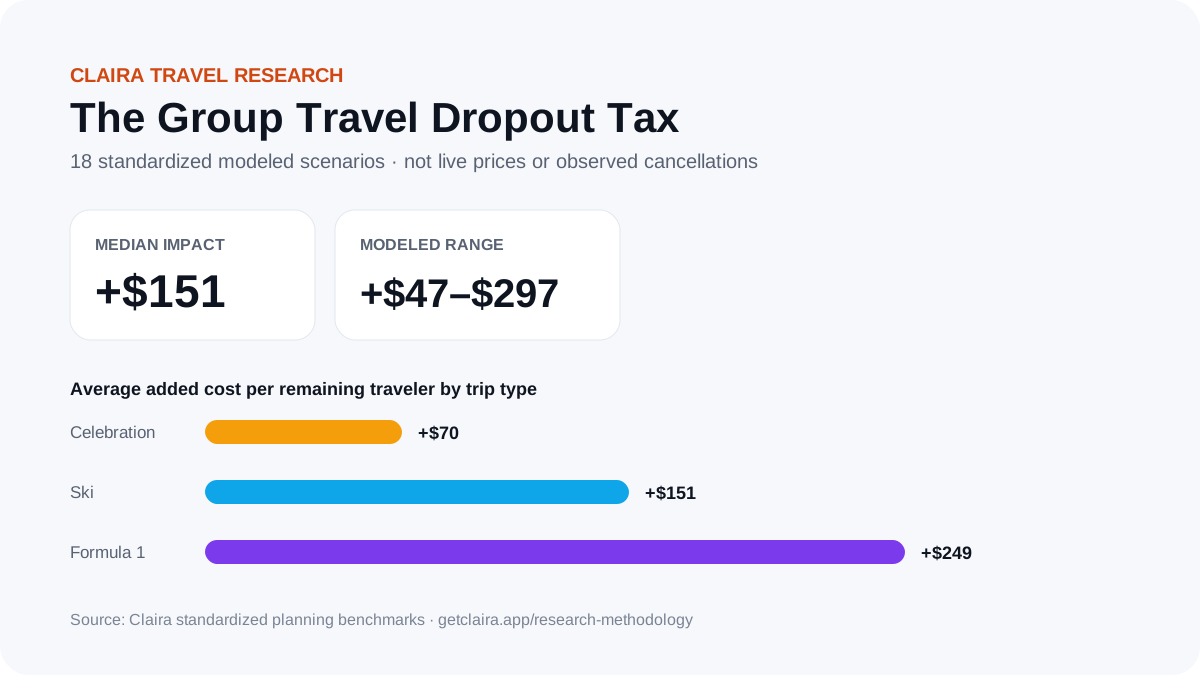
Across all 18 standardized cases, the median one-person dropout tax is about $151 per remaining traveler. The average is about $157, but the spread matters more than the average: the modeled impact ranges from $47 to $297 each.
Finding 1: smaller groups absorb the biggest shock
The six Formula 1 scenarios use six travelers. Their average modeled dropout tax is roughly $249 per remaining traveler.
The celebration scenarios use eight or ten travelers and average about $70. Ski trips use eight and average about $151.
This is not because Formula 1 is uniquely fragile. It is mainly arithmetic: when a fixed booking is split six ways, losing one traveler removes one-sixth of the planned contribution. In a ten-person group, the same fixed-cost structure has more people left to absorb the change.
The practical rule is simple:
The smaller the confirmed group, the more dangerous it is to stretch the lodging or shared-booking budget to the maximum everyone can barely afford.
Finding 2: expensive trips are not automatically the riskiest
Expected trip cost and dropout tax are related, but they are not the same thing.
A trip can be expensive because of individual airfare, lift tickets, race tickets, meals, or personal activities. Those costs disappear with the traveler. The real dropout exposure comes from fixed shared commitments that remain after the traveler leaves.
That is why organizers should track two numbers:
- expected all-in cost per person
- fixed shared cost per committed traveler
The second number tells you how much of the budget depends on everybody else staying in.
Finding 3: celebration trips can hide fixed-cost risk inside one premium choice
The six celebration examples range from +$47 in New Orleans to +$112 in Miami after one dropout.
Miami's modeled case has a larger premium shared-booking bucket and a smaller group than Nashville or New Orleans. That makes the group more sensitive to a cancellation even before considering replacement flights or hotel changes.
A house, boat, cabana, driver, table, chef, or private activity can create the same dynamic in any destination.
This is why the question should not be “Can ten people afford this?” It should be:
Can the committed group still afford this if one person leaves?
Finding 4: ski trips create a middle tier of cancellation exposure
Ski trips are loaded with shared costs: condos, rental vehicles, airport transfers, grocery runs, and sometimes prepaid lessons or group experiences.
The modeled dropout tax ranges from +$120 in Park City to +$186 in Niseko.
The longer international Niseko case has the largest fixed-cost burden in the ski set. Park City's short airport transfer and shorter modeled trip help keep shared exposure lower.
See the full ski trip cost benchmark.
Finding 5: premium event weekends are where commitment discipline matters most
In the six modeled F1 trips, one dropout costs the remaining group between $190 and $297 each.
Las Vegas is the highest case because the standardized example includes the greatest fixed shared-cost exposure. Abu Dhabi and Singapore are close behind.
That means an organizer should be particularly careful about:
- booking premium hotel configurations around tentative travelers
- paying for shared transportation before commitment deadlines
- fronting large event expenses without reimbursement rules
- letting “I'm probably in” count as a confirmed traveler
See the full F1 trip cost benchmark.
The commitment buffer rule
A simple planning rule is to calculate the trip twice:
Base case: committed headcount.
Stress case: committed headcount minus one traveler.
If the stress case pushes the required trip cost above what the remaining group said it can comfortably pay, the booking is too aggressive.
The group then has four options:
- choose cheaper lodging
- reduce the fixed shared-booking budget
- collect nonrefundable commitments before booking
- add a contingency buffer everyone agrees to in advance
Who should carry the risk?
The organizer should not silently become the insurer for the trip.
Before a large fixed booking, the group should agree on:
- what counts as committed
- deposit deadlines
- whether deposits are refundable
- who absorbs a nonrefundable share if someone drops
- whether a replacement traveler can take over the spot
- how bedroom changes affect lodging splits
Claira's product goal is to make these rules visible before money moves, rather than force one organizer to renegotiate them after a cancellation.
How the dropout tax is calculated
The benchmark keeps the modeled individual costs unchanged for the travelers who remain and re-divides the same fixed shared costs over one fewer person.
In simplified form:
Dropout tax per remaining traveler = fixed shared costs ÷ (N - 1) - fixed shared costs ÷ N
where N is the original modeled group size.
That is why fixed-cost exposure and headcount matter more than the destination name.
The Claira takeaway
The most useful group-trip budget is not the optimistic total. It is the budget that still works after something changes.
Across these 18 standardized trips, a single cancellation adds about $151 per remaining traveler at the median, with the modeled high reaching nearly $300 each.
That is large enough to change whether a trip feels affordable—and large enough that commitment rules belong in the planning process, not in an emergency group chat three weeks before departure.
Stress-test your group trip around the travelers who are actually committed, then keep the budget, votes, flights, stays, and itinerary together in Claira →All figures are derived from Claira's standardized illustrative planning benchmarks. They are not live prices, cancellation statistics, forecasts, or guarantees. Actual exposure depends on your booking terms, fixed costs, headcount, refunds, and replacement-traveler options.