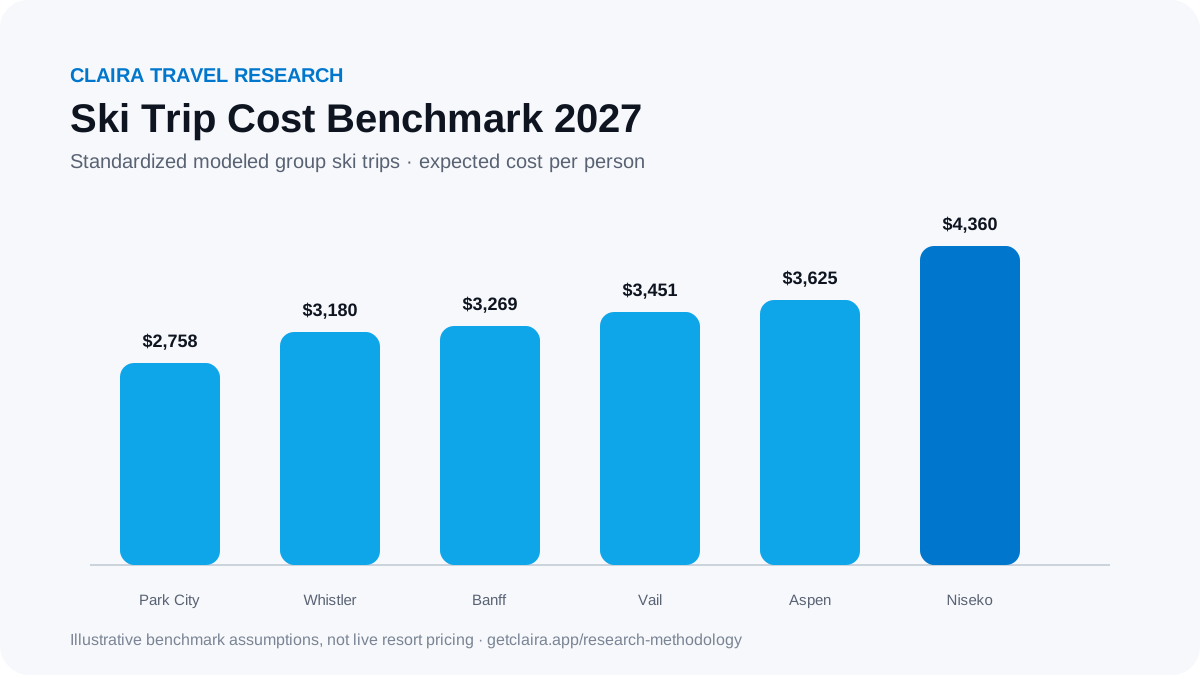
Ski Trip Cost Benchmark 2027: 6 Group Destinations Compared
Multiple ski destinations
Research dataset
Download the modeled data behind this benchmark
The six standardized ski-trip scenarios used in Claira's 2027 benchmark, including modeled trip length, headcount, expected per-person cost, sensitivity range, and one-person dropout impact.
Standardized modeled planning scenarios only. These files are not live prices, customer-trip data, market averages, observed cancellation statistics, or forecasts.
Ski trips are unusually hard to compare because airfare, lodging, lift access, transfers, rentals, food, and trip length all move at once. A resort that looks cheaper on hotel rate alone can become more expensive once the group adds a long transfer, extra nights, or fixed shared costs.
To make the comparison useful, Claira modeled six popular group ski destinations with one consistent planning framework. These are not live quotes, forecasts, or recommended spend. They are standardized assumptions designed to expose the structure of each trip.
The benchmark
| Destination | Modeled trip | Expected per person | Sensitivity range | One-person dropout impact |
|---|---|---|---|---|
| Park City | 5 nights / 8 travelers | $2,758 | $2,386–$3,363 | +$120 |
| Whistler | 5 nights / 8 travelers | $3,180 | $2,753–$3,875 | +$143 |
| Banff / Lake Louise | 6 nights / 8 travelers | $3,269 | $2,827–$3,989 | +$138 |
| Vail | 5 nights / 8 travelers | $3,451 | $2,989–$4,203 | +$158 |
| Aspen | 5 nights / 8 travelers | $3,625 | $3,138–$4,419 | +$161 |
| Niseko | 7 nights / 8 travelers | $4,360 | $3,771–$5,320 | +$186 |
Important: what these numbers are—and are not
This is a planning benchmark, not a live-price survey. We intentionally use rounded example inputs so every destination can be compared with the same logic.
The model includes:
- estimated airfare per traveler
- total shared lodging
- shared ground transport
- food per traveler per day
- ski-day / activity spending
- shared premium costs
- nightlife / après spending
- other shared trip costs
It then shows a lower-spend sensitivity case, a higher-spend sensitivity case, and what happens to fixed shared costs when one traveler drops out.
Replace every assumption with real quotes before booking.
Why Park City models lowest
Park City's biggest structural advantage is the short airport transfer from Salt Lake City. That allows a shorter five-night trip to still feel worthwhile and reduces the need for expensive transfer infrastructure.
Our standardized Park City case models:
- 8 travelers
- 5 nights
- $450 airfare per traveler
- $5,200 total lodging
- $800 total ground transport
- $95 food per traveler per day
- $650 ski/activity spend per traveler
- $400 shared premium cost
- $250 après/nightlife per traveler
- $300 other shared costs
That produces an expected modeled cost of $2,758 per person.
For groups traveling from several U.S. cities, Park City is often the easiest place to begin the ski-trip conversation because transfer friction is unusually low.
Whistler: higher modeled lodging with a different trip profile
Whistler's modeled $3,180 per person sits above Park City largely because the example uses higher lodging and transfer assumptions. The standardized scenario pairs that higher modeled cost with a destination-village setup and a trip profile that groups may value differently from the other cases.
If a slope-side condo costs more but removes taxis, rental cars, and repeated coordination, the higher lodging line may still be rational.
Compare Whistler vs Park City for groups.
Aspen vs Vail: premium trips with different cost structures
Aspen models at $3,625 per person and Vail at $3,451 under our standardized cases. The gap is not a claim that Aspen is always more expensive. It reflects the assumptions we chose for this planning scenario.
Aspen's example carries a larger lodging and individual-spend assumption, while Vail's model carries more shared transport pressure. Both become materially more expensive when the group books premium lodging and several high-cost extras.
Compare Aspen vs Vail for groups.
Niseko: the highest modeled trip—and the least comparable trip length
Niseko is modeled as a seven-night trip because the long-haul travel and Hokkaido transfer are harder to justify for only four or five nights. That longer duration is a major reason the modeled per-person total reaches $4,360.
The trip includes higher airfare, a larger transfer line, and more total food days. That does not mean Niseko is poor value; it means the trip should be evaluated as a larger vacation rather than a domestic long weekend.
Compare Niseko vs Whistler for groups.
The dropout tax
Ski trips have large fixed costs: condos, private transfers, shared vehicles, and sometimes prepaid group experiences. If one traveler drops after the group books, the remaining travelers absorb those costs.
In our benchmark, one dropout raises the expected cost per remaining traveler by roughly:
- Park City: $120
- Banff / Lake Louise: $138
- Whistler: $143
- Vail: $158
- Aspen: $161
- Niseko: $186
This is why Claira recommends building the lodging decision around the committed headcount, not the optimistic invite list.
How to use this benchmark
Use the benchmark to ask better questions, not to choose a resort blindly.
- Replace the airfare assumption with each traveler's actual route.
- Replace lodging with the specific room or condo configuration the group would book.
- Separate lift access and rentals from optional lessons or premium activities.
- Model the transfer at the actual arrival spread.
- Stress-test the fixed costs if one traveler drops.
- Compare the trip on both cost and group fit.
Our takeaway
In this standardized model, Park City has the lowest modeled per-person cost. Whistler, Aspen, and Vail carry higher modeled totals under their stated assumptions, while Niseko is structured as a longer international trip and therefore is not directly comparable with a short domestic ski weekend. Use these modeled differences as planning context, then replace the assumptions with current quotes and the group's actual priorities.
Browse the best ski trips for groups or use the group trip cost calculator with your own assumptions.
All figures are illustrative Claira planning assumptions, not live prices, quotes, forecasts, or guarantees. Actual airfare, lodging, lift access, transfers, food, and activities vary by date, inventory, traveler, exchange rate, and booking timing. See our research methodology before using modeled figures.